
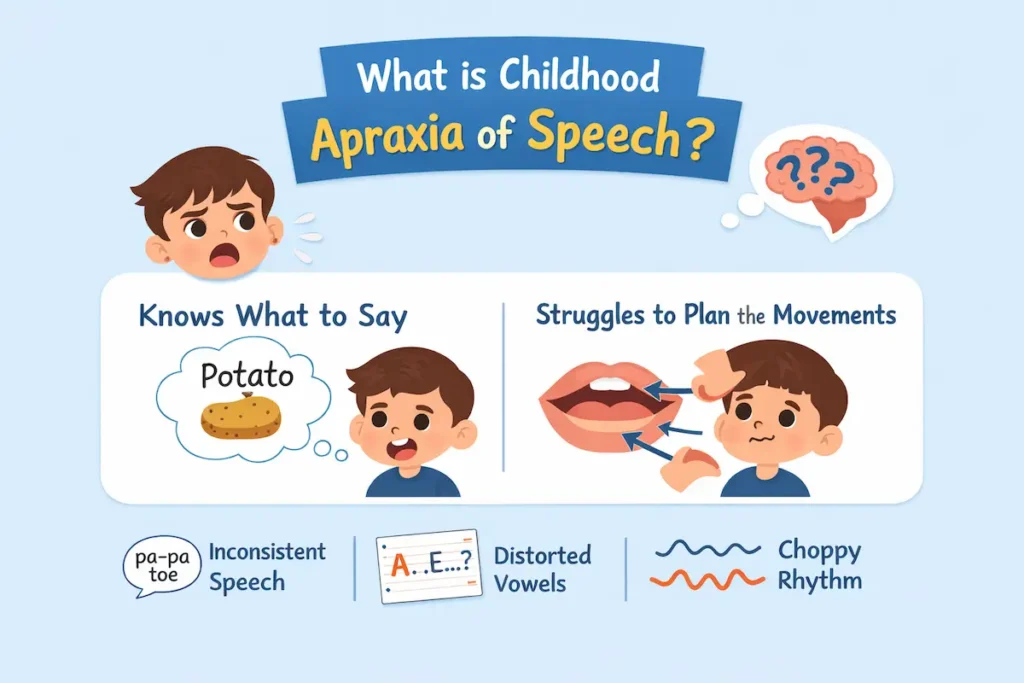
Childhood Apraxia of Speech (CAS) is a neurological motor planning disorder affecting how the brain plans, sequences, and programs the movements required for speech.
It is not:
- A muscle weakness disorder
- A simple articulation delay
- A behavioral refusal to speak
- Caused by parenting or lack of stimulation
It is a disruption in motor planning and motor programming for speech.
Understanding that distinction changes how therapy must be delivered.
What Actually Breaks Down in Childhood Apraxia of Speech (CAS)?
Speech production involves:
- Conceptualizing the message
- Linguistic formulation
- Motor planning
- Motor programming
- Execution
In CAS, the breakdown occurs in stages 3 and 4 — planning and programming.
The child knows the word.
The muscles can move.
But the brain struggles to generate a stable, repeatable motor plan.
This results in:
- Inconsistent speech errors
- Vowel distortions
- Difficulty transitioning between sounds
- Prosodic abnormalities
- Greater difficulty with longer utterances
The instability is neurological, not behavioral.
Core Diagnostic Features of Childhood Apraxia of Speech (CAS)
According to consensus features outlined by American Speech-Language-Hearing Association, three markers differentiate CAS:
1. Inconsistent Errors on Repeated Productions
The same word may be produced differently across attempts.
2. Lengthened and Disrupted Coarticulatory Transitions
Difficulty moving smoothly from one sound to the next.
3. Inappropriate Prosody
Abnormal stress, rhythm, or intonation patterns.
These features must be evaluated dynamically — not through static articulation testing alone.
Why Traditional Articulation Therapy Often Fails in CAS
Articulation therapy assumes:
- The child has a sound error pattern.
- The motor plan is stable.
- Practice reinforces correct placement.
In CAS:
- The motor plan is unstable.
- Repetition without hierarchy does not generalize.
- Accuracy collapses when cues are removed.
Treating CAS like a phonological delay leads to:
- Slow progress
- Plateauing
- Parent frustration
- Mislabeling as “non-compliant”
CAS requires a motor learning framework, not a phonological correction model.
Motor Learning Science in CAS Therapy
Speech is a complex motor skill.
Motor learning research demonstrates that effective learning requires:
- High repetition volume
- Massed practice initially
- Immediate, specific feedback
- Gradual cue fading
- Transition from blocked → random practice
- Increasing variability over time
Children with CAS do not improve from occasional exposure.
They require structured intensity.
Many motor-based clinicians recommend dozens to hundreds of practice trials per session, depending on tolerance and age.
Neural stability emerges through repetition.
Evidence-Based Motor-Based Approaches
Dynamic Temporal and Tactile Cueing (DTTC)
DTTC is a hierarchical cueing method emphasizing:
- Simultaneous production
- Immediate imitation
- Delayed imitation
- Independent production
It integrates:
- Visual cues
- Auditory models
- Tactile input
- Rate control
The goal is motor plan stabilization before linguistic expansion.
Kaufman Speech to Language Protocol
This approach shapes motor approximations into accurate productions by:
- Starting with simple syllable shapes
- Gradually increasing complexity
- Avoiding overwhelming transitions
- Reinforcing success before expansion
The focus remains motor sequencing.
PROMPT Therapy
PROMPT incorporates tactile-kinesthetic cues to guide:
- Jaw grading
- Lip rounding
- Tongue elevation
- Speech timing
It supports sensory-motor integration.
Why Intensity Changes Outcomes
CAS is not a condition that resolves with passive growth.
Progress correlates strongly with:
- Therapy frequency
- Repetition density
- Parent involvement
- Consistency of motor targets
Short daily structured practice often produces better outcomes than infrequent longer sessions.
Motor learning requires distributed neural strengthening.
Clinical Case Illustration
A 4-year-old child could produce “mama” clearly but inconsistently produced “baby.”
With structured repetition:
- 15–20 trials per target
- Hierarchical cue fading
- Blocked practice first
- Gradual variability introduction
The transition between /b/ and vowel stabilized over weeks.
The vocabulary did not change dramatically —
the motor plan did.
This distinction is essential.
CAS vs Articulation Delay (Advanced Differentiation)
Articulation Delay:
- Rule-governed substitutions
- Predictable phonological patterns
- Stable motor plans
CAS:
- Inconsistent productions
- Motor sequencing instability
- Prosodic disruption
- Breakdown under increased length
Misclassification delays appropriate intervention.
Early Identification and Red Flags
Parents often report:
- Limited canonical babbling
- Reduced consonant inventory
- Delayed first words
- Word loss
- Better automatic speech than volitional speech
- High frustration during communication attempts
Formal diagnosis often occurs after age 3, when speech motor expectations are clearer.
The Role of AAC in Childhood Apraxia of Speech (CAS)
Organizations such as Apraxia Kids advocate integrating augmentative and alternative communication (AAC) when needed.
AAC:
- Reduces frustration
- Supports language development
- Does not inhibit speech
- Allows participation while motor speech develops
AAC complements motor therapy — it does not replace it.
Long-Term Outlook
With appropriate motor-based intervention:
- Speech intelligibility improves significantly
- Academic participation strengthens
- Social confidence increases
- Literacy skills can be supported proactively
Some children may require ongoing support for complex language and literacy tasks, particularly where phonological processing intersects with motor planning.
Early, intensive intervention improves prognosis.
Final Clinical Perspective
Childhood Apraxia of Speech is not “just a delay.”
It is a motor planning disorder requiring:
- Structured repetition
- Intentional cueing
- Hierarchical progression
- Neural stabilization
When therapy aligns with motor learning science, progress becomes measurable and meaningful.
Parents who understand the motor nature of CAS become effective partners in intervention.
Frequently Asked Questions About Childhood Apraxia of Speech
What is Childhood Apraxia of Speech?
Childhood Apraxia of Speech (CAS) is a neurological motor speech disorder where the brain has difficulty planning and programming the movements required for speech, despite normal muscle strength.
What are the early signs of Childhood Apraxia of Speech?
Early signs may include limited babbling, delayed first words, inconsistent speech errors, vowel distortions, difficulty combining sounds, and unusual speech rhythm.
How is CAS different from an articulation delay?
Articulation delays involve consistent sound errors with stable motor plans. CAS involves inconsistent productions, difficulty transitioning between sounds, and prosodic abnormalities due to motor planning instability.
Can Childhood Apraxia of Speech be cured?
CAS is not “cured,” but children can make significant progress with structured, intensive, motor-based speech therapy that stabilizes speech motor patterns.
What is the best treatment for CAS?
Evidence-based motor approaches such as Dynamic Temporal and Tactile Cueing (DTTC), Kaufman Speech to Language Protocol, and PROMPT therapy are commonly used to treat CAS.
Does using AAC delay speech in children with CAS?
No. Research and organizations like Apraxia Kids confirm that AAC supports communication and does not prevent speech development.
How often should therapy occur for CAS?
Motor learning research suggests frequent, high-repetition sessions are most effective. Short daily structured practice often produces better outcomes than infrequent sessions. READ ABOUT AAC
About the Author
Shabana Tariq, Speech-Language Therapist
Shabana is the founder of Spectra Speech and has extensive experience designing structured motor-based therapy plans for children with CAS. She provides parent training, individualized therapy consultation, and digital speech development programs.
Need Individual Guidance?
If your child has been diagnosed with Childhood Apraxia of Speech or you suspect motor speech difficulties, structured intervention matters.
Book a personalized consultation to:
• Review your child’s speech profile
• Understand therapy intensity needs
• Create a targeted home practice plan
• Clarify next steps confidently