
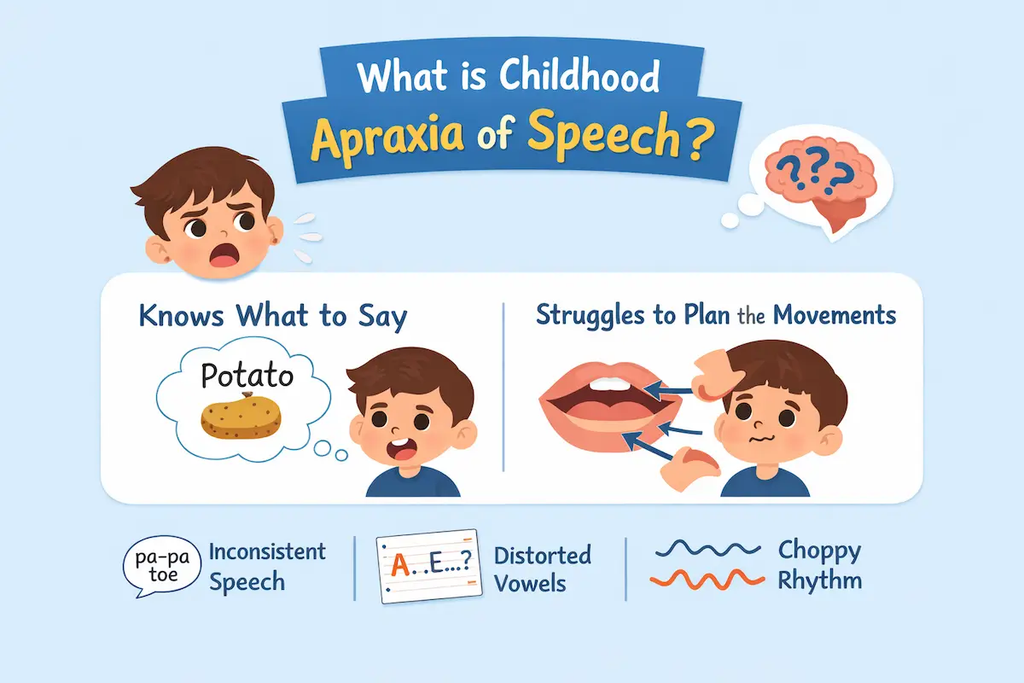
If your child clearly knows what they want to say but the words come out different every time they try — or barely come out at all — you’re probably exhausted from Googling at midnight, trying to figure out if this is “just a phase” or something more. Take a breath first: nothing you did caused this. It’s not a discipline issue, and it’s not because you didn’t read to them enough.
What you may be seeing is Childhood Apraxia of Speech (CAS) — a motor speech disorder that’s often misunderstood, misdiagnosed, or mistaken for stubbornness. This guide walks through what CAS actually is, the signs to watch for, why standard speech therapy often doesn’t work for it, and what real, evidence-based treatment looks like — in plain language, without losing the clinical accuracy that actually matters for your child’s progress.
What’s Really Going On
Think of speech like sending a message from your brain to your mouth. For most children, that message travels cleanly every time. With CAS, the message is intact — your child knows exactly what they want to say — but the signal gets disrupted on its way to the muscles that move the lips, tongue, and jaw.
More precisely, speech production happens in stages: forming the message, choosing the words, planning the movements needed to say it, programming those movements into sequence, and finally executing them. In CAS, the breakdown happens specifically at the planning and programming stages. The muscles are capable. The word is known. But the brain struggles to build a stable, repeatable plan for how to move.
This is why CAS looks so different from a typical speech delay. It’s not that a sound is wrong the same way every time — it’s that the same word can come out differently across different attempts. That inconsistency is neurological, not behavioral, and it’s the clearest signal that something other than a simple delay is happening.
The Core Diagnostic Features
Speech-language pathologists look for three consensus features (outlined by the American Speech-Language-Hearing Association) that differentiate CAS from other speech disorders:
- Inconsistent errors on repeated productions — the same word changes across attempts.
- Lengthened, disrupted transitions between sounds — difficulty moving smoothly from one sound to the next.
- Inappropriate prosody — unusual stress, rhythm, or intonation.
These need to be observed dynamically, across multiple attempts, by someone trained specifically in motor speech disorders — not read off a checklist at home.
Signs to Watch For, by Age
Under 18 months
- Little to no babbling, or a very limited range of sounds
- Noticeably quieter than same-age peers
18 months–3 years
- Very few spoken words, or words that seem to disappear after once being used
- A large gap between what your child understands and what they can say
- Visible frustration during attempts to communicate
- Speech that’s clearer in automatic phrases (like a memorized song) than in spontaneous talking
3 years and older
- The same word sounds different every time it’s attempted
- Longer words or phrases are much harder than short ones
- Choppy speech rhythm, or stress landing on the wrong syllable
- Speech that’s hard for others — even close family — to understand
Formal diagnosis often isn’t confirmed until after age 3, once expectations for consistent speech motor patterns are clearer. But if a few of these sound familiar earlier than that, it’s worth a proper look — not a diagnosis from an article, but a real conversation with someone who specializes in this.
Why “Wait and See” Doesn’t Apply Here
Many speech delays resolve with time, exposure, and general practice. CAS is different — it responds to a specific kind of motor-based therapy, not general speech stimulation. The earlier the right intervention starts, the more efficiently a child’s speech motor planning tends to develop. Waiting doesn’t give the underlying motor planning issue a chance to resolve on its own.
Why Standard Articulation Therapy Often Falls Short
Traditional articulation therapy assumes a child has a consistent sound-error pattern, and that repeated correct practice will reinforce accurate placement. CAS breaks that assumption:
- The motor plan itself is unstable, so repetition without a clear hierarchy doesn’t generalize.
- Accuracy often collapses the moment support or cueing is removed.
- Progress plateaus, and children are sometimes mislabeled as “not trying” or “non-compliant.”
This is why some families describe years of therapy with very little movement — not because their child wasn’t capable, but because the type of therapy didn’t match the type of problem.
The Motor Learning Approach
Because CAS is fundamentally a motor planning issue, effective therapy borrows from motor learning science — the same principles used in athletic or musical skill development. Children with CAS generally need:
- High repetition — often many trials per target within a session
- Massed practice early on, shifting toward more varied practice over time
- Immediate, specific feedback on each attempt
- Gradual fading of cues, from heavily supported production toward independence
- A deliberate progression from simple, blocked practice toward complexity
Occasional exposure isn’t enough to build a stable motor pattern. Structured intensity is what drives change.
Evidence-Based Treatment Approaches
Dynamic Temporal and Tactile Cueing (DTTC) — a hierarchical approach moving a child from producing a sound simultaneously with the therapist, to immediate imitation, to delayed imitation, to independent production — combining visual, auditory, and tactile cues to stabilize the motor plan before expanding vocabulary.
Kaufman Speech to Language Protocol — shapes early motor approximations into accurate productions, starting with simple syllable shapes and gradually increasing complexity, always reinforcing success before pushing further.
PROMPT Therapy — uses tactile-kinesthetic cues (physical touch cues on the jaw, lips, and face) to guide correct movement for jaw grading, lip rounding, and tongue placement.
Each takes a different route, but they share the same logic: stabilize the motor plan first, then expand language on top of it.
A Short Case Example
A 4-year-old could say “mama” clearly and consistently, but produced “baby” differently almost every time. Using structured repetition — 15 to 20 trials per session on that specific word, cues gradually withdrawn, blocked practice before introducing variation — the transition between the /b/ sound and the following vowel stabilized over several weeks.
Notably, the child’s vocabulary didn’t change much during this period. What changed was the reliability of the motor plan itself. That’s often the most important thing for parents to understand: progress in CAS isn’t always about learning new words — it’s about making existing ones consistent.
CAS vs. Articulation Delay
Articulation delay
- Rule-governed, predictable substitutions (e.g., always saying “wabbit” for “rabbit”)
- The motor plan itself is stable — it’s just inaccurate
Childhood Apraxia of Speech
- Inconsistent productions of the same word
- Motor sequencing instability
- Prosodic disruption
- Breakdown that worsens as words or phrases get longer
Getting this distinction right matters — treating CAS like an articulation delay tends to delay real progress.
Myth Check: “Will Pictures or an AAC Device Stop My Child From Talking?
No — and this fear is backed the wrong way. Giving a frustrated child a reliable way to communicate (pictures, gestures, or a device) reduces frustration and supports, rather than replaces, spoken language development. Organizations like Apraxia Kids are clear on this: augmentative and alternative communication (AAC) allows a child to participate in communication while motor speech skills are still developing. Children generally attempt speech more, not less, once the pressure of being misunderstood is relieved.
This is also where the right tools can help in practice — I am building an app Articulation hub with Apraxia and another an AAC app specifically for this, so parents and therapists can generate personalized, core-vocabulary picture supports in minutes rather than searching for generic ones that don’t quite fit a child’s actual needs.
Supporting Speech at Home
Structured, motor-based therapy is central to progress, but a few habits help between sessions:
- Model, don’t correct. If your child says “ba” for “ball,” just say “ball!” back naturally — no “say it again” pressure. Repeated positive modeling works better than correction.
- Slow down your own speech slightly when talking to them, giving their brain a clearer pattern to track.
- Celebrate the attempt, not just accuracy. Every attempt is the motor system practicing.
These aren’t a replacement for therapy — but alongside it, they make a real difference.
Why Intensity Matters
Progress in CAS correlates strongly with therapy frequency, repetition density, parent involvement, and consistency of the specific targets being practiced. Short, structured daily practice — even a few focused minutes — often produces better outcomes than infrequent, longer sessions, because motor learning depends on distributed practice over time, not occasional bursts of effort.
Long-Term Outlook
With appropriately intensive, motor-based intervention, most children with CAS show significant improvement in speech intelligibility over time. Academic participation and social confidence typically strengthen as speech becomes more reliable, and because CAS can intersect with phonological processing, some children benefit from proactive literacy support alongside speech therapy.
It’s rarely instant, and it does take real commitment — but it is absolutely something you can move through together, and early, intensive intervention consistently correlates with better long-term outcomes.
Frequently Asked Questions
What is Childhood Apraxia of Speech? A neurological motor speech disorder in which the brain has difficulty planning and programming the movements needed for speech, despite normal muscle strength.
How is CAS different from an articulation delay? Articulation delays involve consistent, rule-governed sound substitutions with a stable motor plan. CAS involves inconsistent productions and disrupted rhythm or transitions, due to instability in motor planning itself.
Can CAS be cured? CAS isn’t “cured” overnight, but with structured, intensive, motor-based therapy, children can make substantial, lasting progress in speech clarity and consistency.
Does using AAC delay speech development? No — research and organizations like Apraxia Kids confirm AAC supports communication and does not prevent or delay spoken language development.
How often should therapy happen? Motor learning research favors frequent, high-repetition sessions. Short, structured daily practice tends to outperform infrequent, longer sessions.
Let’s Figure Out What Your Child Needs — Together
Reading about CAS is a good first step. But every child’s speech profile is different, and the fastest way to stop guessing is to have someone who does this every day actually listen to your child.
I’m Shabana Tariq — a speech-language therapist with 24+ years of experience, specializing specifically in Childhood I’m Shabana Tariq — a speech-language therapist with 24+ years of experience, specializing specifically in Childhood Apraxia of Speech, AAC, and motor speech disorders, with published research on this work in Communication Matters (2026), grounded in the same ASHA-recognized diagnostic framework referenced above. I’ve spoken on Apraxia and AAC at international workshops and conferences — including Speech Apraxia UK, the Smartbox 24 Hours of AAC Global Conference, and the University of Leeds — and I’ve worked directly with families across India, the UK, and internationally. I know exactly how overwhelming this stage feels.
Book a personal consultation with me, and in one conversation we’ll:
- Look closely at your child’s specific speech patterns
- Tell you plainly whether what you’re seeing fits CAS — or something else
- Map out exactly what kind of therapy intensity your child needs
- Give you 2–3 things to start doing at home immediately
You don’t have to keep piecing this together alone at midnight. Let’s talk about your child, specifically.
👉 Schedule your consultation now — Book here spots are limited, and the sooner we start, the sooner things get clearer.