If you’ve been told, “He’s just a late talker,” but something feels different — you are not imagining it.
Many parents of children later diagnosed with Childhood Apraxia of Speech say the same thing:
“He understands everything… but getting words out seems so hard.”
Childhood Apraxia of Speech (CAS) is a motor planning disorder. The brain knows what it wants to say, but has difficulty planning and coordinating the movements needed for speech.
The question most parents ask is:
How early can you notice the signs?
Can CAS Be Seen in Babies?
A formal diagnosis is rarely made before age 3 because speech expectations are still developing. However, early motor speech differences can sometimes be observed in infancy.
According to the American Speech-Language-Hearing Association, early indicators may include:
- Reduced canonical babbling
- Limited consonant variety
- Minimal sound play
Not every quiet baby has CAS. But persistent motor-related speech differences deserve monitoring.
Early Red Flags by Age
6–12 Months
At this stage, babbling is practice for future speech. It is motor rehearsal.
Watch for:
- Limited babbling (few “bababa” or “mamama” sounds)
- Mostly vowel sounds
- Quiet compared to peers
- Few different consonant sounds
- Minimal imitation of sounds or facial play
What typical development looks like:
- Frequent repetitive babbling
- Sound experimentation
- Back-and-forth vocal play
If babbling is significantly reduced, it may indicate early motor planning instability.
12–18 Months
By this age, most toddlers begin using a small set of meaningful words.
Red flags may include:
- Very few spoken words
- Heavy reliance on gestures over vocalization
- Difficulty imitating simple sounds like “ba” or “ma”
- Vowel-heavy attempts (“uh” for everything)
- Words that appear one week and disappear the next
Parent descriptions often sound like:
- “He said it once but never again.”
- “Some days he can say it, some days he can’t.”
In CAS, motor plans do not stabilize easily, so consistency is affected.
18–24 Months
This is when the receptive–expressive gap often becomes clearer.
Watch for:
- Fewer than 20 meaningful words
- Inconsistent production of the same word
(“ball” sounds different each time) - Difficulty combining sounds
- Visible frustration when trying to speak
- Better understanding than speaking
Parents commonly say:
“She understands everything but can’t say much.”
That gap can be significant in suspected CAS.
2–3 Years
By this stage, speech concerns are usually more obvious.
Possible signs include:
- Limited word combinations
- Speech that is difficult to understand
- Unusual stress patterns (odd rhythm or emphasis)
- Difficulty with longer words
- Groping mouth movements
- Effortful speech attempts
Not all late talkers have CAS.
But persistent inconsistency + effortful speech is a strong indicator.
CAS vs. Late Talking
It is critical to understand the difference.
| Feature | Late Talker | Suspected CAS |
|---|---|---|
| Error pattern | Consistent | Inconsistent |
| Word attempts | Clear attempts | Effortful, searching movements |
| Vocabulary growth | Gradual increase | Slow + unstable |
| Prosody | Typical rhythm | Choppy or unusual stress |
| Imitation | Improves with modeling | Often difficult |
Late talkers usually follow predictable sound patterns.
Children with CAS struggle with motor sequencing.
Why Early Motor Practice Matters
CAS is not a language disorder.
It is a motor learning disorder.
Motor skills improve through:
- Repetition
- Structured cueing
- Practicing sound transitions
- Gradual increase in complexity
- High-frequency practice
Waiting does not automatically stabilize motor plans.
Early identification allows earlier neural organization.
When Should You Seek an Evaluation?
Consider booking a speech evaluation if:
- Your child has fewer than 20 words at 18–24 months
- Speech is highly inconsistent
- Babbling was limited
- Speech attempts appear effortful
- There is persistent frustration
- Receptive language is strong but expressive output is minimal
Early intervention improves clarity outcomes and reduces frustration.
What an Early Evaluation Looks Like
A qualified speech-language therapist will assess:
- Consonant inventory
- Imitation ability
- Sound sequencing
- Prosody
- Response to cueing
- Motor planning stability
Dynamic assessment is essential in suspected CAS.
This means the therapist evaluates not only what your child can say — but how they respond to structured support.
What You Can Do While Waiting
If you suspect CAS, you can begin gentle motor support at home:
- Model simple syllables (ba, ma, pa)- check our apraxia worksheets
- Encourage imitation during play
- Focus on 5–10 highly functional words
- Keep words short and repetitive
- Avoid correcting harshly
- Support communication through gestures or alternative methods if needed
Early structure builds neural stability.
Frequently Asked Questions
Can a 1-year-old be diagnosed with Apraxia?
Diagnosis before age 3 is rare, but early motor speech differences can be observed.
Is CAS caused by parenting?
No. CAS is a neurological motor planning difficulty.
Will my child outgrow Apraxia?
CAS requires structured motor-based intervention. It does not typically resolve without targeted therapy.
Does inconsistent speech always mean CAS?
No. But persistent inconsistency combined with motor difficulty warrants evaluation.
Final Thoughts
Childhood Apraxia of Speech often reveals subtle early markers before diagnosis:
- Limited babbling
- Inconsistent words
- Motor sequencing difficulty
- Effortful speech attempts
If you are uncertain, seeking clarity early provides direction and peace of mind.
Early support strengthens long-term communication outcomes.
No results found
Author
Shabana Tariq, Speech-Language Therapist
Shabana is the founder of Spectra Speech and has extensive experience designing structured motor-based therapy plans for children with CAS. She provides parent training, individualized therapy consultation, and digital speech development programs.
Need Individual Guidance?
Book a personalized consultation below:
• Review your child’s speech profile
• Understand therapy intensity needs
• Create a targeted home practice plan
• Clarify next steps confidently
Staff picks
-
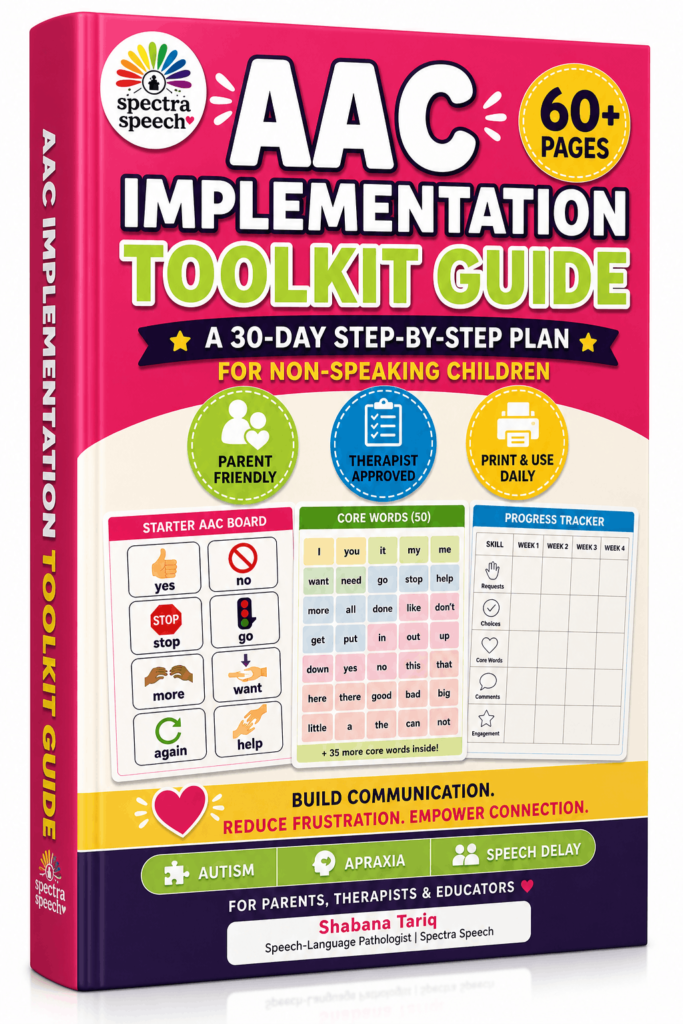
AAC IMPLEMENTATION TOOLKIT GUIDE
Original price was: 3,500.00₹.3,000.00₹Current price is: 3,000.00₹. -

Beyond First Words
800.00₹ -
First Words Activation Code | 30-Day Speech Guide- 12 activities
Original price was: 2,500.00₹.1,600.00₹Current price is: 1,600.00₹. -
Foundational Apraxia Practice Printables
Original price was: 1,500.00₹.1,000.00₹Current price is: 1,000.00₹.